
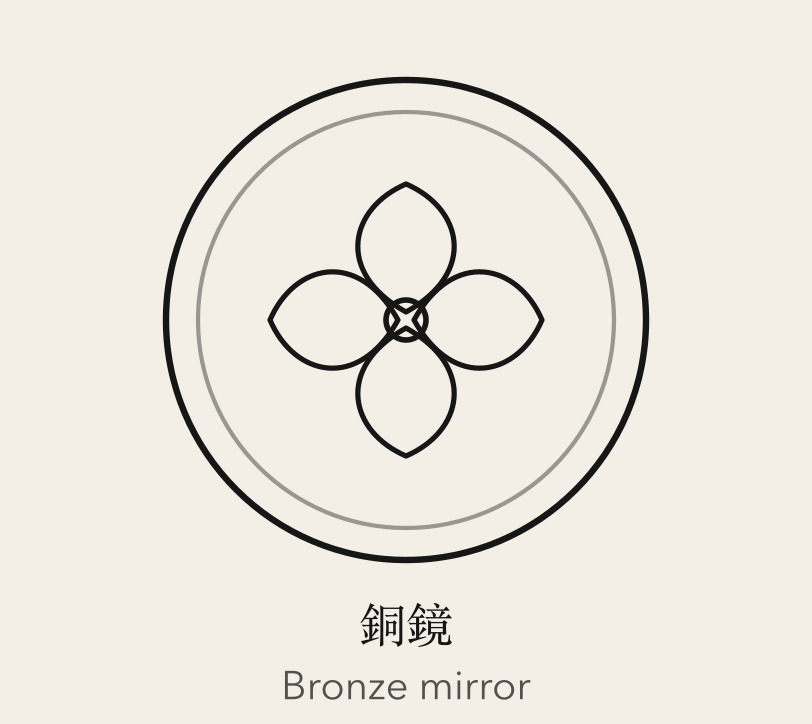
Short answer: The mirror is two circles and four petals. The petals are one closed curve, copied by turning it a quarter turn about the center. A small circle in the middle is the knob. The ink is #161616, and nothing is filled. The drawing is a type of round bronze mirror, not a tracing of one excavated mirror.
What the picture has to read as
A round mirror is recognized by a rim, a flat field, and a knob at the center. Four fat petals in that field make it a decorated mirror rather than a blank ring. The petals have to be round. Pointed petals read as a star, and a star above a page is a different object.
On the page these strokes sit on #f2f2f0. The figure below is on rice paper, #f3eee6, so it matches the other drawings here.
How the rim is built
The view of the mirror, before the caption, is 160 wide and 160 tall. The center is (80, 80). Strokes are #161616, fill none, round caps, round joins.
The rim is a circle of radius 60, width 1.6. Its top is y=20 and its bottom is y=140.
A second circle, radius 52, width 1.05, opacity 0.4, sits on the same center. It is the inner edge of the rim. At full strength it would split the face into two mirrors.
The knob is a circle of radius 5, width 1.4, on the same center. It is drawn after the petals, so it sits on top of them.
How one petal is built
Each petal is a closed path of two cubics, width 1.3, fill none. The top petal is:
M80 46 C94 52 98 68 80 78 C62 68 66 52 80 46 Z
It starts at (80, 46), bows out through (94, 52) and (98, 68), arrives at (80, 78), and returns through (62, 68) and (66, 52). The outer end is 34 units above the center. The inner end is 2 units above the center, so the four petals leave a small opening for the knob. The widest controls are 18 units left and right of x=80. That width, against a length of 32 units from outer tip to inner tip, is what keeps the petal fat. A control pulled farther out would make a point.
The other three petals are the same curve turned about (80, 80) by a quarter turn. Turning (x, y) so that a step right becomes a step down, the top petal’s start (80, 46) lands on (114, 80), which is where the right petal starts.
The right petal is M114 80 C108 94 92 98 82 80 C92 62 108 66 114 80 Z.
The bottom petal is M80 114 C66 108 62 92 80 82 C98 92 94 108 80 114 Z.
The left petal is M46 80 C52 66 68 62 78 80 C68 98 52 94 46 80 Z.
The four outer tips are (80, 46), (114, 80), (80, 114), and (46, 80). They lie on a circle of radius 34 about the center, inside the faint ring at radius 52, so the petals do not touch the rim.
How the drawing is placed
The caption is centered on x=80. The Chinese line is 銅鏡, family Songti SC, then STSong, then Noto Serif SC, then a generic serif, size 11.8, fill #161616, baseline y=159.8. The English line is Bronze mirror, family Avenir Next, then PingFang SC, then a generic sans, size 10, fill #161616 at opacity 0.72, baseline y=174.8. The view is extended from 160 to 181 so the words clear the rim at y=140.
On the page the figure is 199px tall and the width follows the view. The extra height is the caption. The mirror stays the size it had before the words were added. It sits in the gap above a login card.
What this size leaves out
A Han mirror often carries an inscription, a ring of arcs, or a scene of animals between the petals. Here the field has four petals and a knob. The metal is not a tone. The rim’s thickness is the pair of circles, and the back of the mirror is the only side drawn. Pointed petals were the first reading that had to be avoided, so the curves stay fat and they stop short of the center.
Why this stays published
We keep it above a login card. A bronze mirror at this size is two circles, one petal closed from two cubics, and that petal turned three more times about the center.
本文由 HoHo 與 AI 協作整理,最後更新於 2026 年 10 月 18 日。