
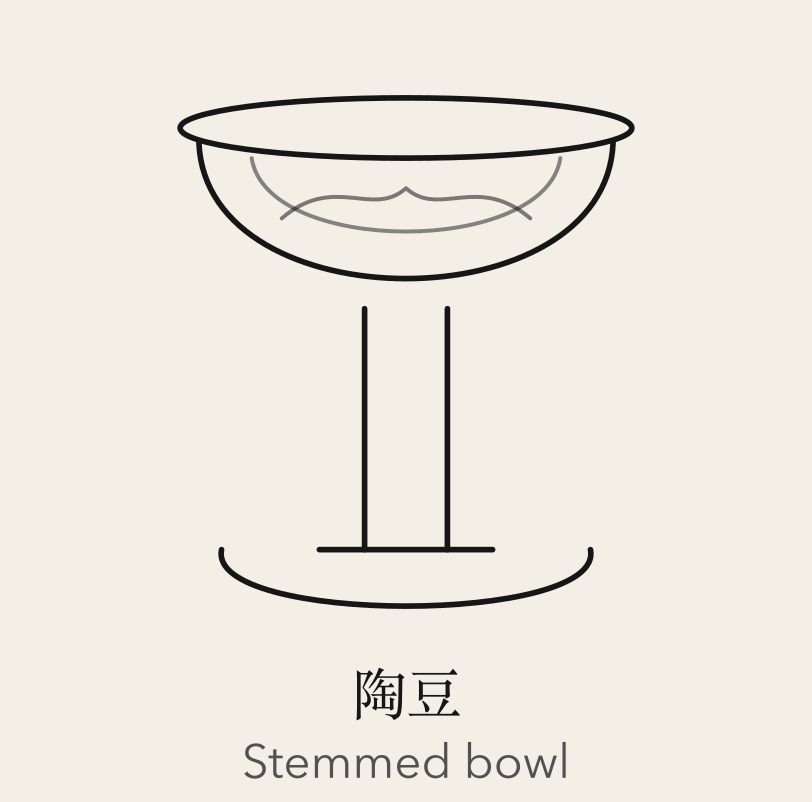
Short answer: The dou is a stemmed bowl seen from the side. The mouth is an ellipse, the bowl is one cubic, the stem is two vertical strokes, and the foot is a second cubic. A lighter wave inside the bowl stands in for a petal. The ink is #161616, and nothing is filled. The drawing is a type of Neolithic stemmed bowl, not a tracing of one excavated pot.
What the picture has to read as
A dou is recognized by a wide mouth, a bowl deep enough to hold something, a narrow stem, and a foot that flares again. A shallow dish on a stick reads as a stand. The bowl has to drop well below the mouth, and the foot has to be wider than the stem.
On the page these strokes sit on #f2f2f0. The figure below is on rice paper, #f3eee6, so it matches the other drawings here.
How the bowl is built
The view of the pot, before the caption, is 170 wide and 200 tall. Strokes are #161616, fill none, round caps, round joins.
The mouth is an ellipse at (85, 34), radius 60 by 8, width 1.5. The center of the whole pot is x=85. The short vertical radius is the near and far lip of a round mouth.
The bowl is one cubic, width 1.5: M30 38 C32 86 138 86 140 38. It runs from (30, 38) to (140, 38). Both controls sit at y=86. Halfway along the curve the point is (85, 74), so the belly bottoms 12 units above the controls and 40 units below the mouth. That depth is what keeps it a bowl.
An inner line repeats the bowl, lighter: M44 42 C48 68 122 68 126 42, width 1.05, opacity 0.5. It is the far wall of the bowl, inset from the rim.
A petal hint crosses the inside, width 1.05, opacity 0.55:
M52 58 C66 46 76 58 85 50 C94 58 104 46 118 58
It starts at (52, 58), rises to the control (66, 46), passes (85, 50), and ends at (118, 58). Two humps are enough. A full flower would compete with the stem.
How the stem and the foot are built
The stem is two vertical strokes, width 1.5, in one path: M74 82 V146 M96 82 V146. They run from y=82 to y=146 at x=74 and x=96. The bowl’s lowest point is (85, 74), so the stem starts 8 units below it. At the size on the page that gap is about 7 pixels, and the eye joins the stem to the bowl. Starting the stem at y=74 would have buried the ends in the bowl stroke.
A short bar joins the stems at the top of the foot: M62 146 H108, width 1.5, from (62, 146) to (108, 146). It is wider than the stem, which is the start of the flare.
The foot is one cubic, width 1.5: M36 146 C32 166 138 166 134 146. It runs from (36, 146) to (134, 146), with both controls at y=166. Halfway along, the curve sits at (85, 161). The foot runs from x=36 to x=134. The mouth runs from x=25 to x=145. The stem runs from x=74 to x=96. The foot is wider than the stem and a little narrower than the mouth. That ratio is the dou.
How the drawing is placed
The caption is centered on x=85. The Chinese line is 陶豆, family Songti SC, then STSong, then Noto Serif SC, then a generic serif, size 14.9, fill #161616, baseline y=188.9. The English line is Stemmed bowl, family Avenir Next, then PingFang SC, then a generic sans, size 12.6, fill #161616 at opacity 0.72, baseline y=206.6. The view is extended to 170 by 213 so the words clear the foot at y=161.
On the page the figure is 148px wide and the height follows the view. It sits in the side margin of a login card.
What this size leaves out
A larger dou often has a pierced stem, a ring of petals outside the bowl, and a foot drawn as a full ellipse. Here the stem is two lines, the petal is one wave inside the bowl, and the foot is a single curve. The mouth is an ellipse, not a circle seen from above.
Why this stays published
We keep it in the margin of a login page, beside the card. A dou at this size is an oval mouth, one deep cubic for the bowl, two stems, and a flared foot wider than the stem.
本文由 HoHo 與 AI 協作整理,最後更新於 2026 年 10 月 18 日。