
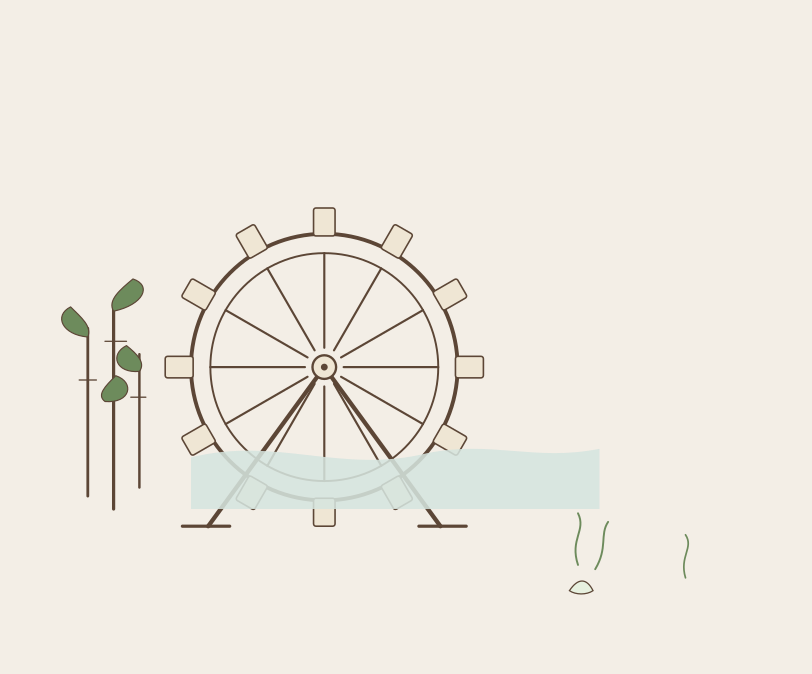
Short answer: The wheel is two circles, twelve spokes, and twelve paddles. An A-frame holds the axle. A pale wash and three posts sit in front, so the lower arc stands in the bank. The spokes and the rims are the plum’s brown, #5c4636. The paddles and the hub are #efe6d4. The wheel turns once every 16 seconds.
What the picture has to read as
A mill wheel is recognized by a rim, spokes that meet at a hub, and paddles outside the rim. The stand is an A. The lower part of the wheel has to disappear into the bank, or the wheel reads as floating.
The ground is the same rice paper, #f3eee6. The wash in front of the wheel is #d5e4df at opacity 0.86, so the spokes stay visible through it.
How one wheel is built
The wheel is its own file. The view is 160 wide and 160 tall, from −80 to 80 on both axes, so the origin is the axle. Y grows downward.
Two circles, fill none, stroke #5c4636. The outer rim has radius 62 and stroke width 1.8. The inner rim has radius 53 and stroke width 0.9.
A spoke is M0-9v-44. It runs from radius 9 to radius 53, and it stops on the inner rim. The same stroke is copied twelve times, rotate by 0, 30, 60, and so on through 330. The step is 30 degrees, exact. Stroke width 1, round caps. The group is fill none, so the open strokes stay lines.
A paddle is a rounded rectangle, 10 wide and 13 tall, corner radius 1.1, fill #efe6d4, stroke width 0.75: x="-5" y="-74". It covers radius 61 to 74. The inner edge overlaps the outer rim by one unit, and the rest of the paddle stands outside the wheel. The same twelve angles place the paddles. They turn with the spokes.
The hub is two circles, painted last. The disk has radius 5.5, fill #efe6d4, stroke width 1.1. The pin has radius 1.6 and is the brown of the spokes, with no stroke. The spokes start at radius 9, so a gap of 3.5 is left between the pin’s disk and the wood.
How the stand and the bank are built
The stand and the bank share one view, 340 wide and 280 tall. The axle in that view is (132, 154). That is the same point the wheel is centered on.
The A-frame is two strokes of width 2, from the axle down to the feet: M132 154L78 228 and M132 154L186 228. Each foot is a short horizontal, width 1.5: from (66, 228) a run of 22, and from (176, 228) a run of 22. Fill none, stroke #5c4636, round caps. This layer is behind the wheel.
The bank is in front of the wheel. A wash covers the lower arc: M70 196c40-10 70 8 110-2 30-6 50 4 80-2v28H70Z, fill #d5e4df, opacity 0.86. It runs from (70, 196) across to (260, 192), then down to y=220 and back.
Three posts stand to the left of the wheel, stroke #5c4636, round caps.
| Post | From | To | Width |
|---|---|---|---|
| Left | (22, 214) | (22, 136) | 1.3 |
| Middle | (34, 220) | (34, 124) | 1.5 |
| Right | (46, 210) | (46, 148) | 1.15 |
A node is a short horizontal on the post: from (18, 160) a run of 8, from (30, 142) a run of 10, from (42, 168) a run of 7, stroke width 0.6. Four leaves, fill #6d8b5c, stroke width 0.55, sit at the tops and on the middle post. Three short green strokes and one small leaf sit on the right of the bank. They are the reeds. The shore beyond this clump is a separate drawing.
Paint the A-frame, then the wheel, then the bank. The wash covers the lower paddles and the feet stay readable through it.
How the drawing is placed
The portal has no stylesheet of its own. The reverse proxy inserts a same-origin link into the head, and inserts the scene in front of the app root. The mill is three images in that scene: the A-frame, the wheel, the bank.
The box is left: 0, bottom: 0, width: min(340px, 46vw), aspect-ratio: 340 / 280. The wheel image is centered on the axle. Its left edge is 38.8235% of the box, which is 132 in the 340-wide view, and its top is 55%, which is 154 in the 280-tall view. The image is then shifted by half its own width and height, so the origin sits on that point. The width is 47.0588% and the height is 57.1429%, and both come out to 160, the size of the wheel’s view.
The turn is rotate(-360deg) over 16 seconds, linear, repeating. The centering translate is written again in the keyframe. A keyframe that only rotates would drop the translate, and the axle would swing.
What this size leaves out
A larger wheel has an axle with bearings, and paddles with thickness. These paddles are flat rectangles, and they turn with the spokes. A gondola that stayed upright would need a second rotation the other way. The rim does not taper. The bank is one wash, not a reflection.
Why this stays published
We keep it at the left of a login page, on the same paper as the plum. A mill wheel at this size is two rims, twelve spokes on a 30-degree step, twelve paddles outside the rim, and an A-frame whose joint is the axle.
本文由 HoHo 與 AI 協作整理,最後更新於 2026 年 10 月 11 日。