
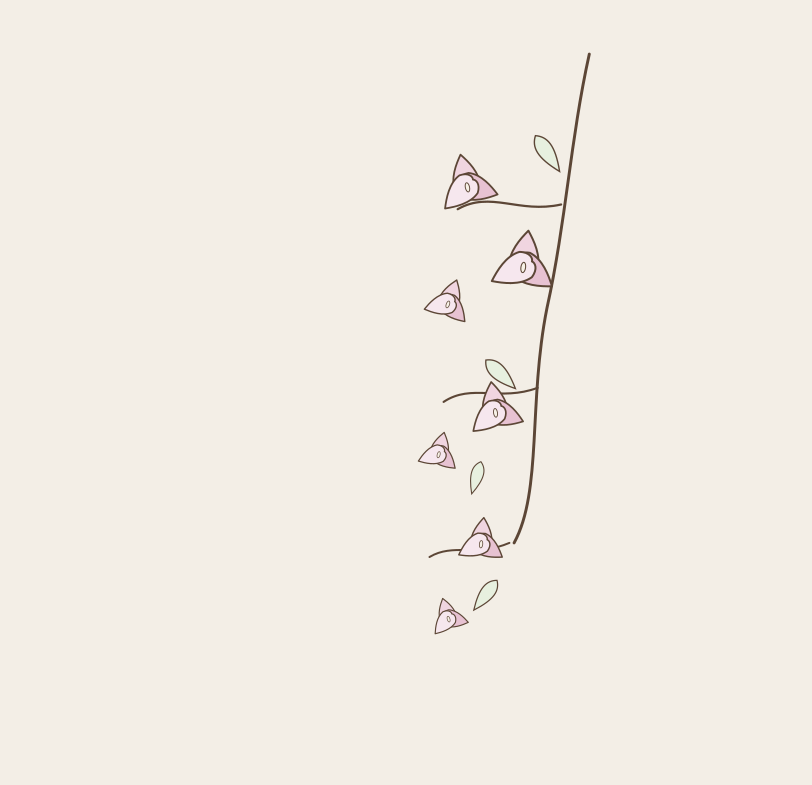
Short answer: One bougainvillea head is the same bract three times, turned about the center, with a small cream tube in the middle. The vine uses that head seven times along a brown cane, with five pale leaves. The bracts are three pinks, #f0d5e0, #e7c2d2, and #f6e7ee. The tube is #f7f1e6. The leaf is #e7f0df. The cane and every outline are the plum’s brown, #5c4636.
What the picture has to read as
A bougainvillea is recognized by three papery bracts around a small true flower, and by a cane that hangs. The bracts are what read as petals. The flower is the tube they hide. At this size each bract is one closed curve, and the tube is one ellipse.
The ground is the same rice paper, #f3eee6.
How one head is built
The head is a symbol drawn at the origin. Y grows downward, so a negative Y is up. The bract is one path of four cubics:
M0-15C3-11 7-5 6 1 4 5 1 5 0 4-1 5-4 5-6 1-7-5-3-11 0-15Z
The tip is (0, −15). The first cubic ends at (6, 1), the right shoulder. The next ends at (0, 4), where the two sides meet. The third ends at (−6, 1), the left shoulder. The last returns to the tip. The controls beside the meeting point sit at y=5, so the base bows past the join and comes back. That bow is the notch. The bract is about 14 wide and 20 tall. Stroke #5c4636, width 0.85, round joins.
The same path is drawn three times. A positive rotation is clockwise.
| Rotation | Fill | Where the tip points |
|---|---|---|
| 0° | #f0d5e0 |
Up |
| 118° | #e7c2d2 |
Down and to the right |
| 236° | #f6e7ee |
Down and to the left |
An even three would step by 120 degrees. The gaps here are 118, 118, and 124. The lower pair was pulled a little together by hand. The palest bract is painted last, so it lies on top where the three overlap. The darker pink is the middle coat.
The true flower is an ellipse at (0, 0.8), rx="1", ry="2.2", fill #f7f1e6, stroke width 0.45. It sits just below the origin. Paint it after the bracts, so the cream tube is in front of the notch.
How the vine is built
The view is 180 wide and 300 tall. The cane is two relative cubics, fill none, stroke #5c4636, width 1.25, round caps: M168 6c-8 36-10 72-18 108-8 40-2 78-14 100. It starts at (168, 6), in the top-right corner of the view. The first cubic ends at (150, 114). The second ends at (136, 214). The cane drifts left as it falls, and it stops there. It does not run off the bottom of the view.
Three twigs leave it and run left, each one cubic, each a little thinner:
| From | To | Width |
|---|---|---|
| (156, 70) | (112, 72) | 0.95 |
| (146, 148) | (106, 154) | 0.9 |
| (134, 214) | (100, 220) | 0.85 |
A leaf is one closed shape, pointed at the top: M0-11C5-7 6-1 0 12-6-1-5-7 0-11Z. The tip is (0, −11). The base is (0, 12). Fill #e7f0df, stroke width 0.75. Five copies are turned and scaled by hand. The transform scales first, then rotates, then moves the leaf into place.
| Place | Rotation | Scale |
|---|---|---|
| (150, 48) | −34° | 0.8 |
| (138, 96) | 24° | 0.68 |
| (130, 142) | −46° | 0.76 |
| (120, 186) | 16° | 0.62 |
| (124, 236) | 38° | 0.7 |
The head is placed seven times. The turn is on the whole cluster, so the three bracts keep the same relation to each other. The only full-size head is the second. The rest were scaled down by hand.
| Place | Rotation | Scale |
|---|---|---|
| (116, 62) | −12° | 0.9 |
| (140, 96) | 8° | 1 |
| (108, 112) | 20° | 0.7 |
| (128, 158) | −8° | 0.84 |
| (104, 176) | 14° | 0.62 |
| (122, 214) | 6° | 0.72 |
| (108, 246) | −16° | 0.58 |
The lowest head, at (108, 246), is the smallest. It hangs past the end of the cane. Paint the cane and the twigs, then the leaves, then the seven heads.
How the drawing is placed
The box is 168px wide and 280px tall, top: 6px, right: 8px. The view is 180 by 300, and the box keeps that proportion. It is in the same margin layer as the other plants, shown only when the viewport is at least 1180px wide, and it does not take clicks. The cane enters from the corner and the twigs reach left, into the page. The clump at the foot of this same margin is a separate drawing.
What this size leaves out
A larger bract has veins and a sharper tip. These three are one curve, turned. The true flower is a tube with a small limb. Here it is one ellipse. The cane is a constant width. The thinner strokes are only on the twigs. There are no thorns, and the leaves are one shape with no midrib.
Why this stays published
We hang it in the upper right corner of an admin page, on the same paper as the plum. A bougainvillea at this size is one bract used three times around a cream tube, and that head stepped down a brown cane.
本文由 HoHo 與 AI 協作整理,最後更新於 2026 年 10 月 11 日。