
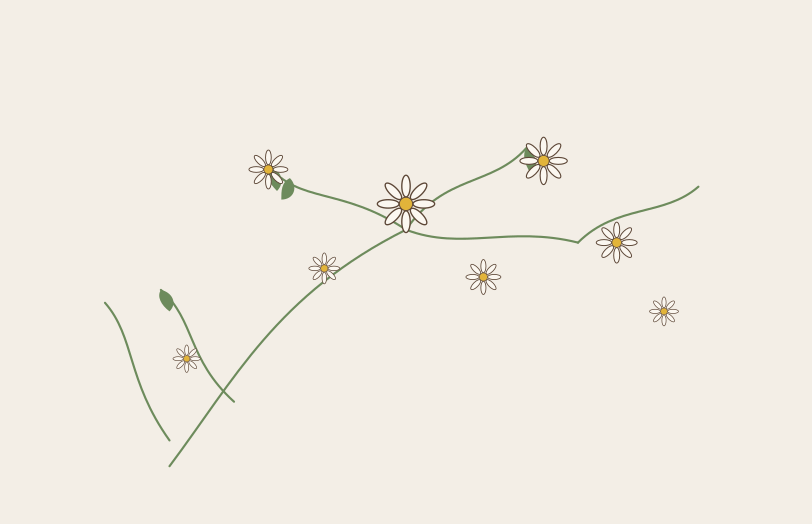
Short answer: One chamomile head is eight ellipses on a regular ring and a gold disk. The plant uses that head eight times, smaller as it leaves the fork, on green stems. The petals are #fbf7f0. The disk is #e2b43a. The outline is the same brown as the plum, #5c4636. The stems and the four small leaves are the bamboo’s green, #6d8b5c.
What the picture has to read as
A chamomile is recognized by a white ray around a gold disk, and by a stem that forks. At this size the rays are ellipses. The disk is one circle. Eight of those heads, stepped down in size, are enough for a clump.
The ground is the same rice paper, #f3eee6. The petals are a step lighter than that paper, so the brown stroke is what separates a petal from the page.
How one head is built
The head is a symbol drawn at the origin. Y grows downward, so a negative Y is up. Eight ellipses share one center. Each has cx="0", cy="-7.2", rx="1.7", ry="4.4", and then a rotation about the origin:
| Petal | Rotation |
|---|---|
| Top | 0° |
| Upper right | 45° |
| Right | 90° |
| Lower right | 135° |
| Bottom | 180° |
| Lower left | 225° |
| Left | 270° |
| Upper left | 315° |
The step is 45 degrees, exact. A petal is 3.4 wide and 8.8 long. Its center sits 7.2 from the origin, so the outer tip is 11.6 out and the inner tip is 2.8 out. Fill #fbf7f0, stroke #5c4636, stroke width 0.55.
The disk is a circle of radius 2.7, fill #e2b43a, stroke width 0.4. The inner tip of each petal falls 0.1 outside that radius. Paint the eight ellipses first and the disk after, so the gold covers the joint.
A rotate on the ellipse turns around the origin, which is the disk. The whole ring is one symbol. Later copies scale that symbol, so the stroke grows and shrinks with the head.
How the plant is built
The view is 300 wide and 210 tall. The stems are open cubics, fill none, stroke #6d8b5c, width 1, round caps. An open curve left filled would paint a wedge. The group keeps fill none.
The main stem is the pattern: M40 200C70 160 90 120 150 90. It runs from the foot (40, 200) to the fork (150, 90). Both controls sit on that rise, so the stem bows once and does not crook.
Three branches leave the fork, and one of them continues:
| From | To | Role |
|---|---|---|
| (40, 200) | (150, 90) | Main stem, up to the fork |
| (150, 90) | (86, 60) | Left branch |
| (150, 90) | (206, 52) | Upper branch, the highest tip |
| (150, 90) | (230, 96) | Right branch, nearly level |
| (230, 96) | (286, 70) | Continuation, a bare tip |
| (40, 188) | (10, 124) | Short stem off the foot, to the left |
| (70, 170) | (36, 118) | Second short stem, to the left |
A leaf is a closed shape of two cubics, fill #6d8b5c, no stroke. The one at the left branch is the pattern: M86 60c6 2 8 8 4 12-4 -4 -6 -8 -4 -12z. The base is (86, 60). The tip is (90, 72). All four point down.
| Base | Tip |
|---|---|
| (86, 60) | (90, 72) |
| (96, 66) | (92, 76) |
| (206, 52) | (208, 64) |
| (36, 118) | (40, 128) |
The same head is placed eight times. None of the copies is rotated. Every disk is upright. The scales were set by hand.
| Place | Scale | Where it sits |
|---|---|---|
| (150, 78) | 1.15 | Largest, 12 above the fork |
| (214, 58) | 0.95 | By the highest tip |
| (248, 96) | 0.82 | On the right branch |
| (86, 62) | 0.78 | On the left branch |
| (186, 112) | 0.7 | Under the fork |
| (112, 108) | 0.62 | Midway up the main stem |
| (270, 128) | 0.58 | Low on the right |
| (48, 150) | 0.55 | Smallest, near the foot |
The largest head is not scale 1. The symbol is drawn small, and this copy is scaled up. Its outer radius is 11.6 × 1.15, about 13.3, so the lower petals reach the fork at y=90. The far tip at (286, 70) carries no head.
Paint the stems, then the leaves, then the eight heads, so the flowers sit on the wood.
How the drawing is placed
The text column is at most 920px wide. The spare width on each side is the gutter. This plant’s left edge is 8px past the column’s right edge: left: calc(100vw - var(--gutter) + 8px), bottom: 0. Its width is the gutter minus 16px, and it stops at 300px. The box keeps the drawing’s proportion, 300 by 210. It is in the same margin layer as the other plants, shown only when the viewport is at least 1180px wide, and it does not take clicks. The plant higher in that margin is a separate drawing. This clump is the one at the foot.
What this size leaves out
A larger chamomile head has more than eight rays, and the disk is a dome of tiny florets. Here the ring is eight ellipses and the disk is one circle. The stems are a constant width. Four leaves hang at the tips, and the rest of the wood is bare. The eight heads differ by a scale. None is turned.
Why this stays published
We set it at the foot of the right margin of an admin page, on the same paper as the plum. A chamomile at this size is eight ellipses on an exact ring, a gold disk, and that head used eight times along a forked green stem.
本文由 HoHo 與 AI 協作整理,最後更新於 2026 年 10 月 11 日。