
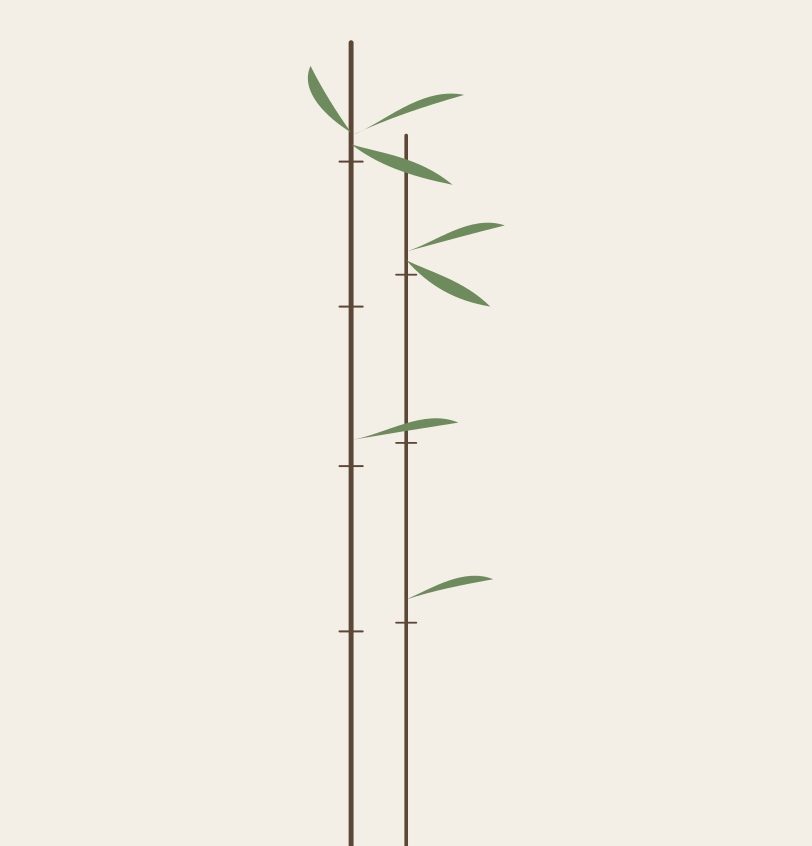
Short answer: The bamboo is two vertical strokes and seven filled leaves. The front culm is thicker and taller. Nodes are short horizontal ticks, and the gaps between them grow toward the foot. Each leaf is two cubic curves that leave a point on the culm and meet at a tip. The culm is the same warm brown as the plum branch, #5c4636. The leaves are a flat green, #6d8b5c, with no midrib.
What the picture has to read as
A bamboo is recognized by a straight culm, a node that is wider than the culm, and leaves that come off in a small group. A painted culm is allowed to lean. This one does not. Both culms are vertical lines, so the plant reads as architecture in a margin rather than a stalk in the wind.
The front culm has to look nearer. It is wider, it rises higher, and it carries the only leaf that points left. The rear culm is thinner, starts lower, and keeps every leaf to the right, so it sits behind the first.
The ground is the same rice paper as the plum, #f3eee6.
How one culm is built
The view is 180 wide and 640 tall. Y grows downward, and both culms run off the bottom edge, so the plant is cut by the page.
The front culm is M58 640 V86, stroke width 3.4. It runs from the foot to y=86. The rear culm is M96 640 V150, stroke width 2.5. It stops at y=150, so its tip is below the front tip. stroke is #5c4636 and stroke-linecap is round. The lines are not filled.
A node is a horizontal stroke centered on the culm, not a ring around it. On the front culm each tick is 16 units wide, from x=50 to x=66, stroke width 1.35, at y=168, 268, 378, and 492. On the rear culm each tick is 14 units wide, from x=89 to x=103, stroke width 1.2, at y=246, 362, and 486.
The gaps lengthen downward. On the front culm they are 82 from the tip to the first node, then 100, 110, and 114. On the rear culm they are 96, 116, and 124. Below the last node the culm continues to the foot with no further tick. That is the usual proportion for the upper part of a stalk: short joints near the tip, longer joints below.
How one leaf is built
A leaf is a closed shape of two cubics. The first cubic is one edge, from the base on the culm to the tip. The second cubic is the other edge, and its end point is the base again. z closes it. There is no stroke and no vein. The fill is #6d8b5c.
The upper-right leaf on the front culm is the pattern: M58 150c22 -8 48 -34 78 -28-28 8 -52 16 -78 28z. The base is (58, 150). The first cubic ends at that base plus (78, −28), which is the tip (136, 122). The second cubic is the other edge and ends at the opposite delta, so it returns to the base. z closes the shape. The two edges bow apart, so the leaf has a belly and a point.
Seven leaves, in the order they are painted:
| Base | Tip | Role |
|---|---|---|
| (58, 148) | (30, 102) | Front cluster, up and left |
| (58, 150) | (136, 122) | Front cluster, up and right |
| (58, 156) | (128, 184) | Front cluster, down and right |
| (96, 230) | (164, 212) | Rear pair, up and right |
| (96, 236) | (154, 268) | Rear pair, down and right |
| (58, 360) | (132, 348) | Front, one flat leaf |
| (96, 470) | (156, 456) | Rear, one smaller leaf |
The three at the front tip share one joint. The two at the rear tip are the 人 arrangement: one up, one down, from one point. Lower down, each culm carries a single leaf, flatter and shorter, so the plant does not stay as busy as the tip.
Six of the seven tips are to the right of their culm. The plant stands in the left margin, and the leaves reach into the page. The one leftward leaf is the exception that keeps the crown from looking combed.
Paint the culms and the nodes first, then the leaves. The green covers the joint where a leaf meets the wood.
How the drawing is placed
The plant is 210px wide and 640px tall, left: -8px, bottom: 0. It is absolute in a layer that does not take clicks. The layer is shown only when the viewport is at least 1180px wide. Below that, the column meets the edge and the culms would lie on the type, so the whole margin drawing is display: none.
What this size leaves out
A painted culm tapers, leans, and changes from wet ink to dry. These two are constant width and perfectly upright. A node in a larger painting is an ellipse that wraps the culm. Here it is a tick. A leaf in that painting has a midrib and a turn at the tip. Here the two curves are the whole leaf, and there is no 介 group of four or 分 group of five. Ink tone does not vary. Near and far are carried by width and height instead.
Why this stays published
We use it in the left margin of an admin page, on the same paper and the same brown as the plum. A margin bamboo is two vertical culms, nodes that lengthen downward, and leaves of two cubics, most of them pointing into the page.
本文由 HoHo 與 AI 協作整理,最後更新於 2026 年 10 月 10 日。